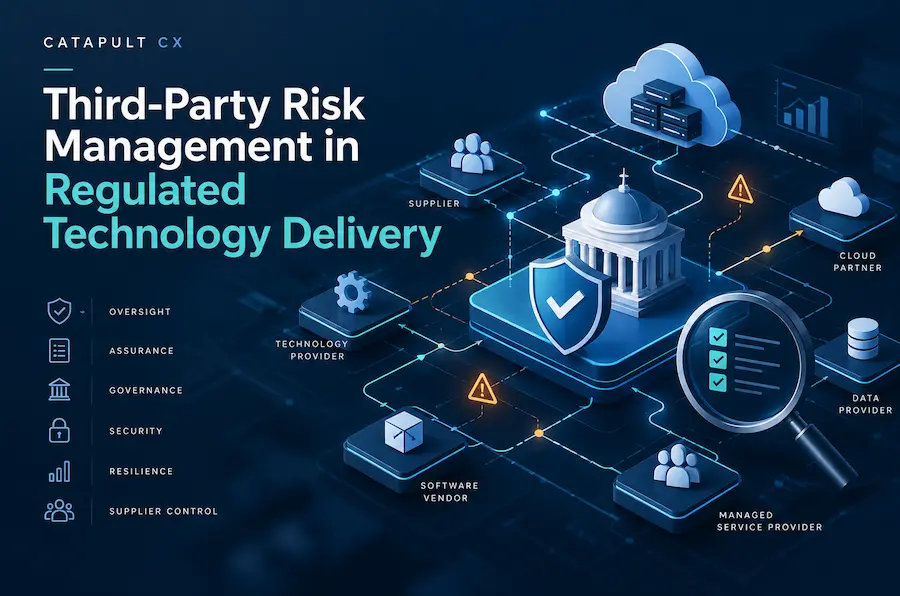

A software product can appear to be progressing while delivery risk is already building beneath the surface.
Software delivery assurance gives senior leaders an evidence-led way to test whether a programme can still deliver before rescue becomes the only option.
Programmes rarely fail because nobody was working. They fail because activity, reporting and confidence gradually become disconnected from delivery reality. By the time the problem is visible, the range of available options is often much smaller.
For transformation programme directors, product leaders, government delivery leads, SROs and CIOs, the issue is rarely whether work is happening. The question is whether the work being reported is still moving the programme towards the intended outcome?
What software delivery assurance means
Software delivery assurance is an independent assessment of whether a software product, product initiative or software-heavy delivery remains capable of achieving its intended outcomes within its constraints, timeline, cost and risk profile.
It is not the same as project management. It is not a PMO update. It is not a supplier confidence statement. It tests whether delivery confidence is backed by evidence.
That evidence should cover delivery, technology and product outcomes, including architecture, integration, dependencies, engineering practices, testing, security, release readiness, governance, business process impacts, customer experience considerations and benefits traceability.
The underlying question is simple. If the product continues on its current path, is it still likely to deliver the outcomes, customer value and business benefits it was intended to achieve?
The term overlaps with project delivery assurance, project assurance and programme assurance. In software contexts, it must also include technical evidence. NIST CSRC defines software assurance as confidence that software functions as intended and is free from vulnerabilities and as-planned activities that ensure lifecycle processes and products conform to requirements, standards and procedures.
In software product delivery programmes, assurance is ultimately about confidence. Not confidence based on reporting, assumptions or supplier reassurance, but confidence supported by technical, delivery and product evidence.
Why delivery assurance matters before a project is visibly failing
Many troubled programmes do not fail in one moment. They drift.
Programmes drift when assumptions stop being tested. Dependencies become normalised, delivery dates become accepted rather than challenged, technical constraints remain unresolved and governance focuses on reporting activity rather than validating outcomes. By the time confidence visibly drops, the options available to leaders are often far more limited.
The warning signs are rarely dramatic. Milestones are reported. Boards receive updates. Suppliers give reassurance. Teams stay busy. But activity is not the same as progress. Leaders need to know whether the programme is still genuinely deliverable.
The earlier delivery assurance happens, the more choices leaders still have. A programme can be corrected, re-scoped, paused, re-planned or supported before the only realistic option is recovery.
If the programme has already tipped into failure, the conversation changes. That is when leaders need to rescue a failing software delivery project. Delivery assurance sits earlier. Its job is prevention.
Delivery confidence is not the same as a green status report
Government delivery leaders will recognise the language of delivery confidence.
NISTA’s 2024–25 Annual Report states that the Government Major Projects Portfolio contained 213 major projects with £996bn whole-life cost and £742bn of monetised benefits. The report also explains that a Delivery Confidence Assessment assesses the likelihood of a project delivering its objectives to time and cost.
But NISTA is clear that Delivery Confidence Assessments are not comprehensive reflections of project performance. They are snapshot assessments of likelihood of success if issues and risks are left unaddressed.
That distinction matters. A green or amber status is useful only if leaders know what sits beneath it.
A programme can report green status while important risks remain unresolved. Architecture decisions may still be open. Critical dependencies may be slipping. Testing may be incomplete. Supplier confidence may be stronger than the evidence supporting it.
Delivery assurance exists to test whether reported confidence is supported by delivery reality.
A status report says what the programme believes is happening. Delivery assurance tests whether that belief is defensible.
What delivery confidence should be based on
Delivery confidence should be based on evidence from the programme itself.
That means asking:
- Is the architecture still fit for the intended outcome?
- Are dependencies understood and owned?
- Is the backlog under control?
- Are releases predictable?
- Are test results improving or just being deferred?
- Are suppliers proving progress or simply reporting effort?
- Are decisions being made quickly enough to protect product delivery?
These questions matter because delivery confidence is rarely undermined by a single issue. It is usually weakened by the accumulation of unresolved dependencies, deferred decisions, technical uncertainty and gaps between reported progress and demonstrable outcomes.
If those questions cannot be answered clearly, confidence is not yet evidence-based.
Delivery confidence should be earned through evidence rather than inherited from reporting structures. Confidence increases when architecture decisions are resolved, dependencies are controlled, releases are predictable and progress can be demonstrated through outcomes rather than activity.
The early warning signs delivery assurance should test
Delivery assurance should look for signals that are easy to miss in standard reporting.
Individual issues rarely cause programmes to fail on their own. More often, delivery confidence is gradually eroded by unresolved dependencies, deferred technical decisions, fragile release processes and weak visibility into progress.
| Signal | What it may mean | What assurance should check |
|---|---|---|
| Milestones are marked complete but outcomes are unclear | Activity may not be translating into measurable progress | Whether completed work maps to user, service or business outcomes |
| Backlog grows faster than throughput | Scope or estimation may be unstable | Backlog health, prioritisation and delivery capacity |
| Architecture decisions remain unresolved | Technical risk is being deferred | Architecture options, trade-offs and decision ownership |
| Releases are slow or fragile | Engineering practices may be blocking delivery | CI/CD, environments, testing and rollback capability |
| Reporting is fragmented across tools | Leadership visibility may be weak | Whether tooling supports reliable governance and dependency management |
| Supplier confidence lacks evidence | Risk may be hidden behind relationship management | Demonstrable outputs, test evidence and release data |
| Critical decisions are repeatedly deferred | Governance may be slowing delivery or decisions may be driven by short-term project priorities rather than longer-term product outcomes | Decision ownership, escalation paths, decision latency and whether decision-makers understand the broader product context and intended customer and business outcomes |
This is where assurance becomes grounded in the product itself. It tests whether delivery is creating value for internal or external customers, separating genuine progress from motion.
Different signals may require deeper investigation. If release, testing or deployment weaknesses are part of the problem, a DevOps health check may be a useful supporting route.
What a software delivery assurance review should examine
A credible software delivery assurance review should examine the programme from both delivery and technical angles.
It should cover:
- Delivery plan realism
- Architecture and technical design
- Integration and dependency risk
- Product scope and backlog health
- Supplier and team capability
- Engineering practices
- Testing and release readiness
- Governance and decision cadence
- Benefits and outcome traceability
None of these areas should be assessed in isolation.
Delivery delays may be caused by architecture constraints. Governance issues may be slowing technical decisions. Backlog instability may reflect unresolved scope or dependency risk. Delivery assurance examines how these factors combine to affect programme confidence.
This is not a generic audit. It is a test of whether the programme can still deliver.
An independent technical review should help leaders understand whether delivery confidence is justified, where the real constraints sit and what intervention, if any, is required before committing further spend or scope.
Technical evidence
Technical evidence should cover the areas that can quietly derail delivery – architecture decisions, maintainability, CI/CD maturity, test strategy, security, resilience and release evidence.
Technical issues rarely appear on programme risk registers as technical issues alone. They often surface as missed milestones, delayed releases, growing backlogs, unresolved dependencies or rising delivery costs. Technical evidence helps leaders understand whether delivery risk is being created by underlying technology constraints rather than execution alone.
The Software Engineering Institute states that architecture is the primary carrier of quality attributes such as performance, modifiability and security. It also says architecture evaluation is a cost-effective way to mitigate substantial risks to system and organisational success.
Where architecture uncertainty or legacy constraints are material, leaders may need a deeper assessment before making further delivery, funding or modernisation decisions. In those situations, a modernisation readiness review may be relevant.
Delivery evidence
Delivery evidence should show whether the programme is moving at a credible pace towards the intended outcome.
That means reviewing roadmap realism, dependency ownership, backlog health, decision latency, sprint or release predictability and supplier performance.
Delivery evidence should show not only what has happened, but whether future commitments remain credible. A programme may report completed milestones while still carrying unresolved dependencies, unstable scope or delivery constraints that threaten future outcomes. Assurance examines whether reported progress is likely to translate into successful delivery.
The National Audit Office has said that an effective central system giving assurance over project progress is critical to successful outcomes and that better-evidenced assurance reports supported HM Treasury decisions.
For senior leaders, the objective is not simply to understand programme status. It is to understand whether delivery confidence is justified and whether intervention is needed before risks become harder and more expensive to address.
When to commission delivery assurance
Delivery assurance is most valuable before a major decision point.
The challenge is that programmes often appear healthiest just before critical decisions are made. Funding approvals, governance reviews and delivery commitments are frequently based on reported confidence rather than independently tested evidence. Assurance helps leaders validate assumptions before they become commitments.
At its core, delivery assurance is testing a simple proposition. If the programme continues as it is today, is it likely to achieve the outcome it was funded to deliver? The review is not validating effort. It is validating the credibility of the delivery path.
Commission it when:
- The programme is high-value or high-risk
- Confidence depends heavily on supplier reporting
- A funding, governance or delivery milestone is approaching
- Timelines look plausible but assumptions feel fragile
- Architecture decisions are unresolved
- Discovery or alpha has created uncertainty
- A new CIO, SRO or programme director has inherited the programme
- Delivery progress is hard to verify
GOV.UK’s Service Manual says that before committing to building a service, teams need to understand the problem, users, constraints, policy intent and opportunities to improve. It also states that discovery should identify constraints such as legislation, contracts, legacy technology, existing processes and systems. Delivery assurance helps leaders determine whether those constraints have genuinely been understood and addressed before larger commitments are made.
If these signals are present, an independent review gives leaders a clearer view before committing more spend, scope or political capital.
What good delivery assurance should produce
Good delivery assurance should not produce another report that sits in a governance pack.
It should produce a decision-ready view of:
- Current delivery confidence
- Evidence-backed risks
- Technical constraints
- Priority interventions
- Ownership gaps
- Decision options
The objective is not simply to identify problems. It is to create enough clarity for leaders to choose a credible path forward.
Those options may include continuing with targeted fixes, re-scoping, resetting governance, changing the supplier model, pausing before further spend or moving into rescue.
The output should be a decision, not just a document. If leaders leave an assurance review knowing more but still unable to decide what happens next, the review has not done its job.
Delivery assurance versus project health check, architecture review and rescue
These terms overlap, but they are not the same.
The confusion often comes from the fact that all four activities assess risk. The difference is the question being asked.
A project health check focuses on current programme status. An architecture review focuses on technical design. Rescue focuses on recovery after significant failure. Delivery assurance sits earlier. Its purpose is to determine whether a programme remains capable of achieving its intended outcome before more costly intervention becomes necessary.
| Term | Best used when |
|---|---|
| Delivery assurance | Leaders need to know whether a programme remains capable of delivering its intended outcome |
| Project health check | A lighter review is needed to identify obvious issues or areas for further investigation |
| Software architecture review | Technical design, scalability or maintainability is the primary concern |
| Independent technical review | Leaders need a deeper assessment of technical constraints, architecture risk and delivery blockers |
| Project rescue | The programme is already failing or confidence has materially dropped |
The important distinction is timing. Delivery assurance is designed to identify and address risks while leaders still have options. Rescue begins when those options have narrowed significantly.
How to act if assurance shows the programme is not on track
If assurance shows the programme is drifting, do not ask for more optimistic reporting. Do not add more people before fixing constraints and do not keep delivering against a plan that the evidence no longer supports.
The right response may be to continue with targeted fixes. It may be to re-scope, reset governance, change supplier responsibilities or pause before further spend. If the programme is already failing, use the evidence to move into recovery with control rather than panic.
The purpose of delivery assurance is not to prove that a programme is healthy. It is to give leaders enough evidence to make better decisions while meaningful options still exist.
Catapult CX’s Trust & Verify Advisory helps leaders determine whether delivery confidence is genuinely supported by evidence, whether the right product outcomes remain achievable and what action is needed before recovery becomes necessary.
FAQs. Software Delivery Assurance
What is software delivery assurance?
Software delivery assurance is an evidence-led assessment of whether a software-heavy programme remains deliverable against its intended outcomes, constraints, timeline, cost and risk profile.
What is project delivery assurance?
Project delivery assurance is the broader discipline of testing whether a project or programme can deliver successfully. In software programmes, it should include technical evidence as well as delivery governance.
What is the difference between delivery assurance and project management?
Project management runs the programme. Delivery assurance independently tests whether the programme remains credible, evidenced and deliverable.
How do you know if a software programme is on track?
You need evidence from architecture, delivery progress, dependencies, testing, release readiness, supplier performance and governance. Status reporting alone is not enough.
What evidence should a delivery assurance review examine?
It should examine delivery plans, architecture, integration risk, backlog health, supplier capability, engineering practices, testing, release readiness and governance.
When should a CIO or SRO commission delivery assurance?
Software delivery assurance is most valuable before major funding, governance or delivery decisions, particularly where confidence depends on assumptions that have not been independently tested. It is often used when delivery progress is difficult to verify, architecture decisions remain unresolved or programme risk is increasing.
When should software delivery assurance be performed?
Software delivery assurance is most valuable before major funding, governance or delivery decisions, when leaders need confidence that the proposed approach is credible and evidence-based. It is equally valuable when delivery begins to slow, confidence starts to decline or important milestones are repeatedly missed, helping leaders understand whether the programme or product remains on track and what intervention, if any, is required.
What are the signs that a software programme may need delivery assurance?
Common signs include unresolved architecture decisions, growing backlogs, fragile releases, delivery milestones that are difficult to verify, heavy reliance on supplier reporting, unclear dependencies and declining confidence in programme status reporting.
What should a software delivery assurance review produce?
A delivery assurance review should produce a decision-ready view of delivery confidence, evidence-backed risks, technical constraints, ownership gaps and recommended interventions. The goal is to support decisions, not create another governance document.