Stop treating your cloud migration like a deadline to hit. It is a strategic transfer of risk. If you do not understand what you are trading, you are not in control of the outcome.
That is the mistake many organisations make. A migration gets framed as a delivery milestone. The target becomes go-live. The executive language becomes speed, cutover, completion and closure.
But none of those things tells you whether the migration has improved the health of the platform, reduced dependency, strengthened resilience or left the business in a better position to change.
A migration can hit the date and still fail strategically. In fact, many do.
That is because migration does not remove risk. It reallocates it. Architectural risk shifts. Data risk shifts. Operational risk shifts. Commercial risk shifts. If you only track whether workloads moved on time, you are not managing the migration. You are managing a date.
For a CIO, that is the wrong measure of success.
What is cloud migration strategy?
A cloud migration strategy is the plan for moving applications, data, infrastructure or services to a cloud environment in a way that improves business outcomes and manages risk. A good strategy defines what should move, what should change, what should be retired, how risk will be controlled and what the organisation should be better able to do after migration.
Why go-live is the wrong definition of migration success
Go-live is a milestone. It is not an outcome.
A cloud migration can be delivered on schedule and still leave the organisation with brittle integrations, poor data structure, rising operating costs, weak interoperability and new forms of vendor dependency. The project is signed off, but the platform is harder to live with.
This is where migration programmes fail quietly. On paper, they succeed. In practice, they leave the organisation carrying the same problems in a more expensive environment.
Pressure builds around timelines, contract exits, infrastructure deadlines or executive commitments. Those pressures are real. But when they become the dominant frame, decision quality drops.
Teams start migrating what exists instead of deciding what deserves to exist.
The result is predictable. The estate moves, but the underlying problems move with it.

Migration does not remove risk. It reallocates it
Every migration is a trade.
You might reduce infrastructure risk but increase supplier dependency. You might simplify hosting but import commercial lock-in. You might improve scalability but expose weak process design. You might modernise part of the stack while preserving old integration logic that still limits change.
Some of these trade-offs are worth making. Some are not. The problem is that many are made implicitly.
That is why the CIO-level task is not to “deliver migration.” It is to decide which risks are worth carrying forward, which must be reduced and which new risks are acceptable in exchange for strategic gain.
Viewed properly, cloud migration is a risk reallocation exercise across four areas.
| Risk area | What migration may reduce | What migration may introduce |
|---|---|---|
| Architecture | Ageing infrastructure, scaling constraints and resilience weaknesses. | New dependency chains, platform-specific design choices and harder reversibility. |
| Data | Fragmented storage, poor access patterns and manual movement of information. | Higher exposure of poor data quality, unclear lineage and weak governance. |
| Operations | Manual infrastructure management and some legacy support burden. | New tooling, skills gaps, observability needs and cloud cost-management pressure. |
| Commercial control | Capital-heavy infrastructure commitments and slow provisioning cycles. | Vendor lock-in, cloud concentration risk and commercial dependency on platform terms. |
If those trade-offs are not explicit, the organisation is not directing the migration. It is absorbing it.
Why regulated organisations need a risk-led cloud migration strategy
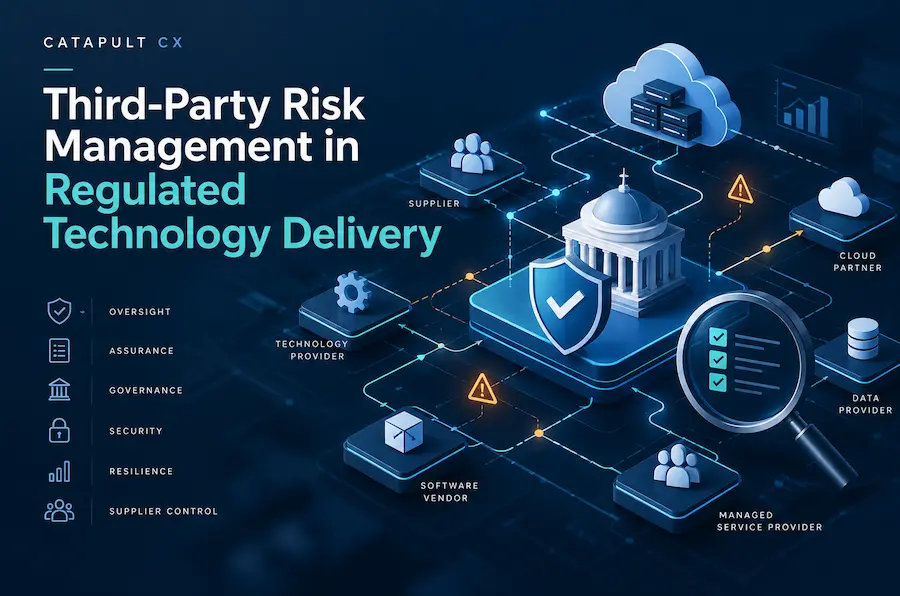
For regulated organisations, cloud migration is not only a technology decision. It can affect operational resilience, third-party risk, data control, auditability and the ability to recover important business services during disruption.
UK financial services firms are under increasing pressure to understand how technology dependencies affect resilience. Operational resilience expectations require firms to identify important business services, understand disruption impact and remain within agreed tolerances during severe but plausible events.
Cloud migration decisions should therefore be assessed against service continuity, recovery, monitoring, supplier dependency and evidence. A workload may be easier to host after migration, but that does not automatically mean the organisation has improved resilience or control.
This matters because cloud can improve resilience, but it can also concentrate dependency. The UK has designated major cloud providers including Microsoft, Google, Amazon and Oracle as critical third-party suppliers to the financial sector, bringing them under direct regulatory oversight. That reflects a wider recognition that cloud providers are not just infrastructure suppliers. For many firms, they are part of the operating fabric of financial services. Read more on the UK critical third-party designation.
A risk-led cloud migration strategy should therefore show not only how systems will move, but how the organisation will maintain control, evidence resilience and avoid replacing legacy infrastructure risk with unmanaged concentration risk.
This is where Trust & Verify Advisory can help technology and risk leaders make delivery decisions more defensible, especially when migration affects critical services, regulated workflows or high-risk customer journeys.
Why legacy problems survive the move
One of the most persistent myths in technology leadership is that cloud migration automatically modernises the estate.
It does not.
Technical debt survives migration unless it is deliberately addressed. Brittle integrations remain brittle. Poorly understood dependencies remain poorly understood. Fragile operating processes do not become robust just because the hosting model changes. Bad data does not become strategic data because it now sits somewhere else.
In many cases, migration makes these weaknesses more expensive. Costs become easier to see. Performance bottlenecks become more obvious. Dependency chains become harder to ignore.
This is where the “cloud tax” shows up. Not because cloud is inherently inefficient, but because legacy problems are now being paid for more transparently.
If the core problem is legacy design, the answer is not to move it faster. It is to decide whether it should survive at all. That is why cloud migration strategy should connect directly to legacy systems modernisation decisions, not sit separately from them.
The new risks cloud migration can introduce
The cloud is not the problem. Poor migration decisions are.
A poorly framed migration introduces risks that are often invisible during delivery and painful afterwards.
Vendor lock-in is one of the most significant. A move that appears to simplify delivery can leave the organisation dependent on proprietary services, constrained by commercial terms and locked into architectural choices that are difficult and expensive to unwind.
Some migration decisions are easy to make and extremely hard to reverse. Vendor lock-in is one of them.
Reduced flexibility is another. Architectures shaped around the migration event rather than the long-term platform often become harder to evolve, not easier.
Operational overhead is another common surprise. New environments bring new cost disciplines, new security models, new tooling requirements and new skills gaps. Teams expecting simplification often inherit a different, more complex operating burden.
There is also the question of monitoring. Cloud platforms can provide better visibility, but only if observability is designed into the target state. Without proper Monitoring, Analytics & Alerting, teams may move into cloud and still lack the operational insight needed to detect, diagnose and recover from issues quickly.
These are not reasons to avoid cloud. They are reasons to treat migration as a set of deliberate risk trades, not a delivery exercise.
Why data quality determines whether the migration pays off
If you want to know whether a migration will create lasting value, look at the data.
Poor data quality and weak structure are often treated as a secondary workstream. That is a mistake. Data defines reporting, automation, compliance, interoperability and future analytics long after the migration is complete.
A migration forces organisations to confront what their data actually looks like: how it flows, what it means and where it is broken. That is one of the few points where meaningful improvement is possible.
If bad structure is carried forward, the target state inherits the same constraints. At that point, the organisation has not modernised. It has just relocated the problem.
Cloud migration strategy steps
A good cloud migration strategy should create clarity before delivery accelerates. The exact sequence will vary, but most effective strategies include seven steps.
| Step | Question to answer | Why it matters |
|---|---|---|
| 1. Define the business outcome | What should be better after migration? | Prevents the programme becoming a technical relocation exercise. |
| 2. Map the current estate | Which applications, data flows, dependencies and constraints exist today? | Exposes hidden complexity before migration decisions are locked in. |
| 3. Classify risk and criticality | Which systems support critical services or carry high operational risk? | Helps sequence work based on business impact, not convenience. |
| 4. Decide what should not move | What should be retired, redesigned or left until better understood? | Stops low-value complexity being preserved in a new environment. |
| 5. Choose the migration approach | Should the workload be retained, retired, rehosted, replatformed, refactored, rearchitected or replaced? | Matches the migration method to the value and risk profile of each workload. |
| 6. Define control and evidence | How will security, resilience, cost, data and supplier risk be evidenced? | Makes the migration defensible, not just deliverable. |
| 7. Sequence by dependency and value | What order reduces risk while improving the platform incrementally? | Prevents migration waves being shaped only by deadlines or contracts. |
For many organisations, the right first step is not another migration plan. It is a Modernisation Readiness Review that clarifies what should move, what should change and what risks need to be reduced before migration accelerates.
Choosing the right cloud migration approach
Cloud migration strategies often fail when every workload is treated the same. Different systems need different approaches based on value, risk, technical condition and future business need.
| Approach | What it means | When it fits |
|---|---|---|
| Retain | Keep the workload where it is for now. | The system is too risky, too unclear or not valuable enough to move immediately. |
| Retire | Remove the workload from the estate. | The system no longer creates enough value to justify migration or support. |
| Rehost | Move the workload with minimal change. | Speed matters and the system is stable enough to move without redesign. |
| Replatform | Make targeted changes to use cloud capabilities. | The workload can gain efficiency or resilience without major redesign. |
| Refactor | Restructure part of the application or codebase. | The current design limits scalability, maintainability or integration. |
| Rearchitect | Change the system architecture more fundamentally. | The target state requires a different operating model, resilience profile or data flow. |
| Replace | Move to a new product, platform or custom solution. | The old system is no longer strategically fit for purpose. |
What good cloud migration strategy actually looks like
A good cloud migration strategy does not start with the estate. It starts with the outcome.
What needs to improve? What risk needs to reduce? What constraint needs to disappear? What flexibility does the organisation need after the move that it does not have today?
Only then should migration scope be defined.
Most migration scopes are too wide. Organisations try to move everything, when the real value comes from deciding what should not survive the move.
That means:
- retiring low-value complexity instead of preserving it
- redesigning critical systems instead of lifting and shifting them
- leaving behind components that are not yet understood well enough to migrate safely
It also means sequencing based on dependency, risk and strategic value, not convenience.
Migration is not about moving the estate efficiently. It is about reshaping it deliberately.
Success should be defined in terms of outcomes: better interoperability, lower cost to change, stronger resilience, reduced dependency, cleaner data and greater control.
A cutover date is not a strategy.
What success really looks like
Successful migration does not mean everything moved. It means the organisation is in a stronger position after the move than before it.
That may mean fewer legacy blockers, lower operational risk, better data quality, reduced commercial dependence or stronger resilience.
In some cases, it may mean deciding not to migrate part of the estate at all until the underlying problem is understood.
That is where most organisations get it wrong. They measure completion, not position.
Migration is not the outcome. It is one step in a broader shift towards a healthier, more adaptable platform.
Three hard questions for a CIO
Before a migration accelerates, ask three questions.
1. What risk are we removing and what risk are we importing?
If that is not explicit across architecture, data, operations and commercial control, the migration is not being managed strategically.
2. What are we carrying into the new environment unchanged?
If technical debt, poor data structure and brittle integrations are moving with the estate, the organisation may just be paying more to keep the same problems.
3. What will be better after the move?
Not what will be live. What will be better? Cost-to-change, resilience, control, flexibility, data quality or operating efficiency?
If those answers are weak, the migration strategy is weak.
The right question for a CIO
The wrong question is: can we migrate by Q4?
The right question is: what are we trying to improve and what risk are we willing to carry to get there?
Migration is not a phase you complete. It is a position you take on risk.
If that position is unclear, the outcome will be too.
If your migration strategy is built around a date rather than a risk model, the next step is not to push harder. It is to decide what should move, what should change and what should be left behind.
That is what turns migration from a project plan into a strategic advantage.
FAQs about cloud migration strategy
What is a cloud migration strategy?
A cloud migration strategy is the plan for moving applications, data, infrastructure or services to a cloud environment while managing business, technical, operational and commercial risk. It should define what moves, what changes, what is retired and what outcomes the organisation expects after migration.
What are the main cloud migration strategies?
The main cloud migration strategies usually include retaining, retiring, rehosting, replatforming, refactoring, rearchitecting and replacing workloads. The right choice depends on the value, risk, complexity and future role of each system.
What are the steps in a cloud migration strategy?
Common steps include defining the business outcome, mapping the current estate, classifying risk and criticality, deciding what should not move, choosing the migration approach, defining control and evidence, and sequencing work by dependency and value.
Why do cloud migrations fail?
Cloud migrations often fail when they are treated as deadline-driven relocation projects. Moving systems to the cloud without addressing technical debt, data quality, operating model, security, resilience and supplier dependency can preserve old problems in a more expensive environment.
What risks should a cloud migration strategy manage?
A cloud migration strategy should manage architectural risk, data risk, operational risk, security risk, cost risk, supplier dependency, vendor lock-in and resilience risk. For regulated organisations, it should also consider auditability, impact tolerances and service continuity.
Is cloud migration the same as modernisation?
No. Cloud migration means moving systems, data or services into a cloud environment. Modernisation means improving the system so it is easier to operate, change, scale or govern. A migration can support modernisation, but simply moving a legacy system to cloud does not automatically modernise it.
How should regulated organisations approach cloud migration?
Regulated organisations should treat cloud migration as a risk-managed change programme. They should map important business services, understand third-party dependencies, define recovery and monitoring requirements, control data movement and ensure evidence is available for audit and operational resilience purposes.
What should be measured after cloud migration?
Success should be measured by whether the organisation is in a better position after migration. Useful measures include resilience, cost to change, platform reliability, data quality, recovery capability, supplier dependency, operating cost, deployment speed and ability to support future change.